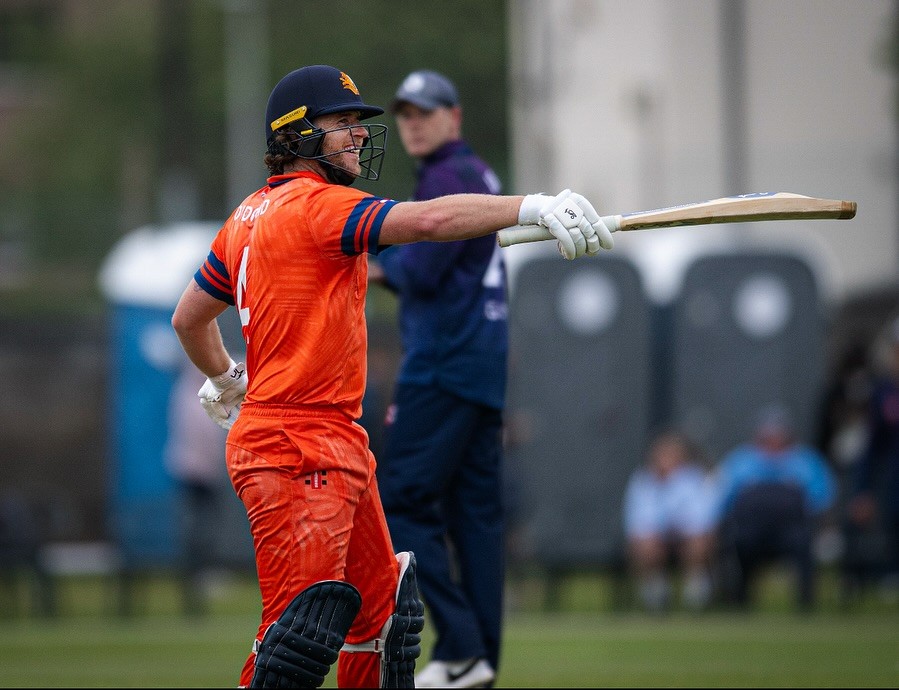
There’s a temptation, when an associate batter produces a year like Max O’Dowd’s, to treat it as a story of overachievement. A purple patch. A player briefly touching the ceiling before gravity resumes control.
O’Dowd’s 2025 doesn’t allow that comfort.
He finished the year as the Netherlands’ leading run-scorer in both T20Is and ODIs, crossed 2,000 ODI runs, produced a career-best 158* in a chase of 369. He deservedly hit the winning shot as well. Pummelling a six to scale the third highest run chase in ODIs is simply stuff of dreams. Something that is even beyond that is playing three Super Overs to decide an outcome of a game. Well, O'Dowd was part of it too in 2025. An event that's never happened in men’s cricket (T20 or List A). Somehow, none of it felt accidental.
“It’s been an amazing year, definitely,” O’Dowd reflects. “Most importantly, the team achieved one of its main goals, which was qualifying for the T20 World Cup (2026). And to be able to contribute with some runs, I think is extremely special,” the Netherlands star tells EuroCrick in an exclusive chat.
The phrasing matters. Contribute. Not carry. Not rescue. O’Dowd consistently frames performance as function, not expression.
That showed most clearly during the 369 run chase against Scotland, a total large enough to collapse teams before a ball is faced. The response, however, was not emotional inflation, but tactical reduction.
“We had a complete five-over by five-over block lined out,” he explains. “The one thing was: whoever comes in, you have to strike it over 100. That simplified everything.”
Simplification is an underrated skill in high-pressure elite cricket, particularly for teams without the safety net of depth, finance, or fixture security. The Netherlands’ success is built less on inspiration than on repeatable processes.
“If you don’t do it, you’re probably going to lose,” O’Dowd adds. “So you may as well give it a crack.”
That same pragmatism runs through how this Dutch side operates off the field. With players scattered across continents, preparation becomes decentralised by necessity.
“We’re in contact pretty much every day,” O’Dowd says. “We’ve been setting ourselves little challenges, cricket-related or uncricket-related. We’re always busy and holding each other accountable.”
Accountability becomes the system when infrastructure isn’t guaranteed.
The upcoming T20 World Cup in India and Sri Lanka amplifies this reality. The Netherlands are grouped with India, Pakistan, the USA and Namibia, a blend of powerhouses, emerging nations and a touch of unpredictability.
“It’s one of the strongest groups there,” O’Dowd says. “While India might start favourites, but there’s an opportunity for all four of those teams to really show up on a big stage.”
Opportunity, again. Not miracle.
Playing India at the Narendra Modi Stadium brings scale and perspective.
“Hopefully it’s sold out,” he smiles. “100,000 people would be awesome. And more importantly, great for the vlog as well.”
In 2025, he scored runs everywhere, won the Tim de Leede Medal, qualified for a World Cup, played a match that required three Super Overs, and still found time to document hotel corridors, training nets, teammates’ habits and of course his coffee making skills.
He understands that modern associate cricket is played on multiple surfaces: the pitch, the funding spreadsheet, and increasingly, the algorithm.
“I just enjoy capturing moments,” he says. “Sometimes it’s probably too much filming, but I just enjoy it.”
The vlogging began accidentally, he reveals. A camera bought to record DJ sets, slowly repurposed for vlogging. Bangladesh became the unlikely launchpad, as the opening batter added consistency to his YouTube channel.
“The Bangladeshi fans, they love seeing it,” O’Dowd says. “It kind of just evolved.”
His optimism around the European T20 Premier League (ETPL) fits the same pattern.
“Franchise cricket around the world has really elevated local games,” he says. “It throws local guys into the deep end early, and that’s often how you learn quickly.”
For O’Dowd, the appeal isn’t just competitive. It’s geographic.
“A franchise league across three of the most exciting European countries, and an opportunity for guys to come to Amsterdam, Dublin and Edinburgh… it’s pretty cool,” he says. “I’m sure it’ll be one of the leading franchise destinations without a doubt.”
That sense of place matters. Associate cricket has long been nomadic, borrowing relevance from wherever fixtures are granted. ETPL offers a different permanence. A league that isn’t just played in Europe, but belongs to it.
O’Dowd’s year isn’t remarkable because it happened. It’s remarkable because it looks sustainable. And that, for associate cricket, might be the most disruptive thing of all.


